
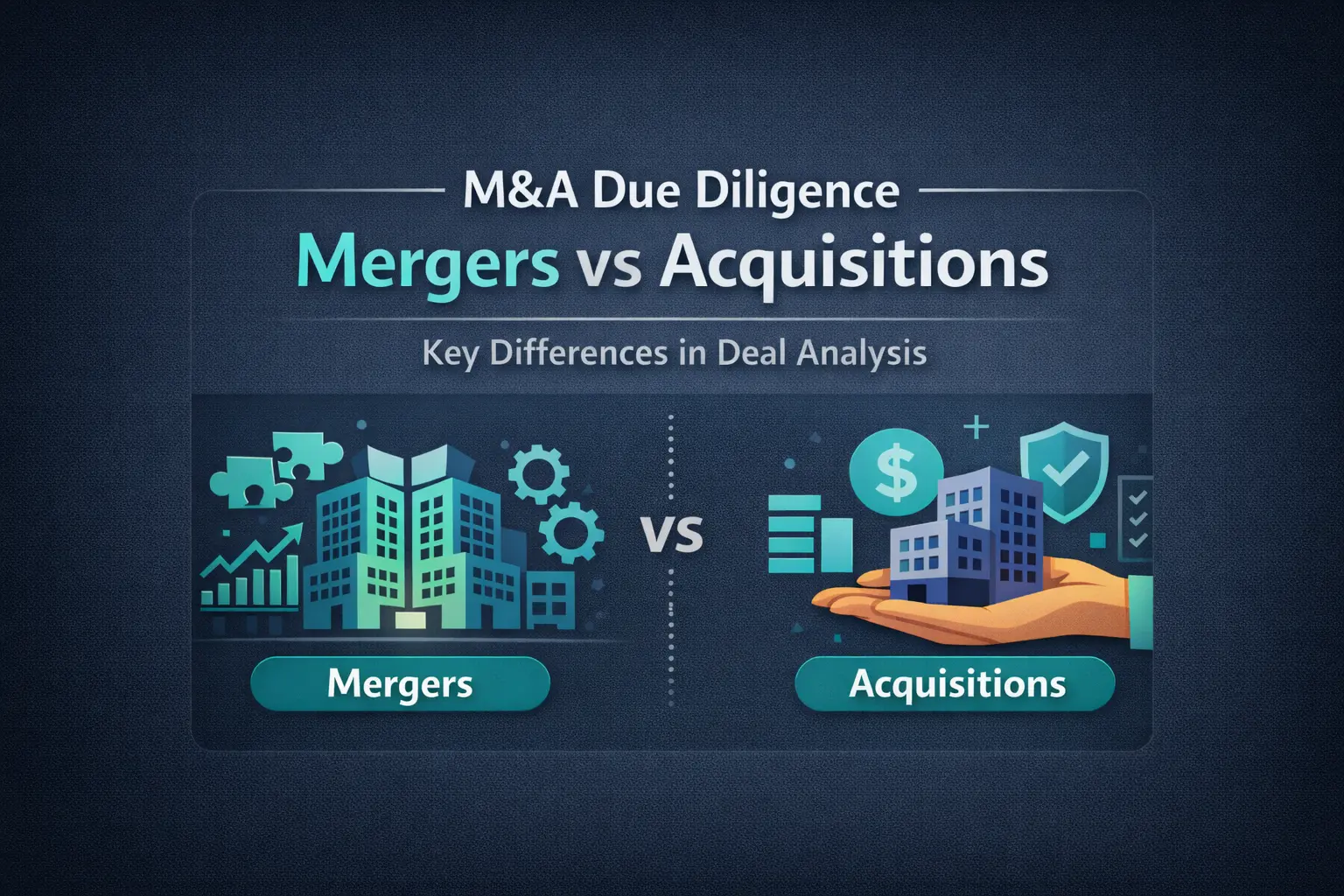
M&A Due Diligence: Mergers vs Acquisitions
Written for M&A professionals conducting due diligence on mergers and acquisitions.
Not All M&A Due Diligence is the Same
M&A due diligence follows fundamentally different playbooks depending on deal structure. While the term "M&A due diligence" encompasses both transaction types, the analysis depth, risk factors, and valuation drivers diverge significantly.
For this article, we distinguish mergers as transactions involving integration of two entities—where overlapping functions, systems, and headcount will be consolidated—from acquisitions where the buyer operates the target as a standalone entity with minimal integration. In mergers, synergy realization drives value creation. In acquisitions, standalone economics justify the purchase price.
These structural differences reshape diligence priorities across every functional area. These are simplified definitions/distinctions, admittedly, but it allows us to pinpoint high stakes topics that could make/break the eventual outcome for all involved; so, let the simplified definitions stand for now.
1. Financial Synergies & Cost Structure Analysis
Mergers
- Exhaustive synergy modeling across every P&L line: duplicate SG&A elimination (e.g., 2 CFOs → 1), vendor contract renegotiation leverage, facilities consolidation
- Overlapping tool subscriptions identified and quantified (CRM, ERP, HR systems, office software)
- Detailed cost-out timelines: which roles eliminated at close vs. 6 months vs. 12 months post-close
- Synergy assumptions often justify 15-30% valuation premiums over standalone economics
Acquisitions
- Pure standalone economics assessment with zero synergy assumptions in valuation models
- Focus on whether the cost structure is sustainable independently and scales without external subsidy
- Validate that operating expenses aren't artificially low due to seller support that won't transfer
- Assess whether the business can operate profitably at current run rate without cost reductions
Key Distinction: Merger diligence validates aggressive synergy targets that justify premium multiples. Acquisition diligence stress-tests whether standalone unit economics support the purchase price without any operational improvements.
2. Technology Stack & Systems Integration
Mergers
- Massive systems consolidation roadmap: which CRM/ERP/HRIS platforms to sunset, which to retain
- Data migration complexity assessment across customer records, financial history, employee databases
- API integration requirements for legacy systems that must coexist during 12-18 month transition periods
- License consolidation opportunities (e.g., Salesforce enterprise agreements that absorb merged users at marginal cost)
- IT headcount rationalization as redundant infrastructure teams are consolidated
Acquisitions
- Ensuring tech stack is functional, well-documented, and scalable without buyer system dependencies
- Identifying technical debt that could impede standalone growth trajectory (legacy code, unsupported platforms)
- Validating that critical systems aren't hosted on seller infrastructure that won't transfer
- Assessing whether key integrations with third-party platforms are transferable or tied to seller contracts
- No integration complexity—focus is on operational continuity post-close
Key Distinction: Merger diligence prioritizes integration complexity and consolidation savings. Acquisition diligence ensures the target can operate independently without inheriting the buyer's infrastructure or requiring expensive decoupling from seller dependencies.
3. Organizational Design & Talent Retention
Mergers
- Redundancy mapping across all functions: when you have 2 VPs of Sales, who gets the combined role?
- Retention priorities for overlapping roles based on performance, cultural fit, and institutional knowledge
- Detailed org chart redesign reflecting consolidated reporting structures and eliminated layers
- Change management for displaced employees: severance budgeting, communication sequencing, legal risk mitigation
- Cultural integration at scale: aligning performance review systems, compensation philosophies, and management styles
Acquisitions
- Retaining the entire team as-is with minimal org chart disruption post-close
- Validating compensation is market-competitive to prevent attrition when employees re-evaluate options post-transaction
- Identifying key person dependencies where single individuals possess critical institutional knowledge
- Ensuring no reporting structure changes that would trigger cultural friction or departures
- Focus on retention incentives for critical roles rather than redundancy elimination
Key Distinction: Merger diligence quantifies headcount reductions as synergy value. Acquisition diligence treats any departures as value destruction and focuses on continuity.
Where Competitive Intelligence Remains Consistent
Regardless of deal structure, understanding the competitive landscape is essential to M&A due diligence. Both mergers and acquisitions require validating differentiation claims, identifying market positioning, and assessing competitive threats. Tools like Jobs-to-be-Done competitor discovery and feature parity analysis apply equally to both transaction types—confirming whether competitive advantages are defensible or commoditized.
M&A Due Diligence: 5 Key Phrases With Deal Structure Implications
The language used during M&A due diligence reveals a nuanced reminder of the distinction between merger analysis or acquisition analysis. These five phrases have fundamentally different meanings (or levels of relevance) depending on transaction type.
1. "Synergy Analysis"
In merger contexts, synergy analysis is the analytical foundation for understanding post-close value creation potential. Teams build detailed models quantifying cost synergies (duplicate role elimination, vendor consolidation, facilities closure) and revenue synergies (cross-selling opportunities, expanded TAM from combined offerings). From the buyer's perspective, synergy validation determines whether the combined entity will generate superior returns (not whether to pay the seller a premium for those synergies). The buyer wants to capture synergy value as upside for their investors, not give it away through higher purchase prices. Rigorous synergy analysis reveals whether integration complexity and execution risk justify the deal structure, or whether projected savings will erode during lengthy, chaotic consolidation efforts.
In acquisition contexts, the phrase "synergy analysis" is a red flag. If your valuation model requires synergies to justify the purchase price, you've misclassified the deal structure. Acquisitions must generate acceptable returns on standalone economics without operational improvements, cost reductions, or revenue enhancement from buyer involvement. When acquisition diligence teams start modeling synergies, they're either conducting stealth integration planning (making it a merger) or rationalizing an overpriced deal.
2. "Standalone Basis"
In acquisition contexts, "standalone basis" is the analytical default—every metric must reflect performance without buyer support. Revenue projections assume no cross-selling from buyer's customer base. Cost structure assumes no shared services or buyer-subsidized functions. Technology assessment validates the platform operates independently without buyer infrastructure. The phrase appears in nearly every diligence workstream: "Assess profitability on a standalone basis," "Validate technical architecture on a standalone basis," "Confirm management team capability on a standalone basis."
In merger contexts, the phrase "standalone basis" appears primarily as a valuation baseline—establishing the target's independent value before layering in synergy premiums. But merger diligence quickly moves beyond standalone metrics to combined entity modeling. Analyzing the target "on a standalone basis" is the starting point, not the analytical framework driving deal decisions.
3. "Integration Planning" vs "Operational Continuity"
In merger contexts, "integration planning" dominates post-LOI diligence workstreams. Teams build detailed integration roadmaps: which systems to consolidate by quarter, organizational design with consolidated reporting structures, customer communication sequencing to minimize churn during transitions, vendor contract renegotiation timing. Integration planning often consumes more diligence resources than financial or commercial analysis, because execution complexity determines whether projected synergies materialize or erode in lengthy, chaotic consolidation efforts.
In acquisition contexts, the equivalent phrase is "operational continuity" — ensuring the target continues functioning post-close without disruption. Diligence validates that employees know their roles aren't at risk, that systems remain unchanged, that customer relationships transfer seamlessly with minimal buyer involvement. If acquisition diligence identifies areas requiring "integration planning," you've uncovered dependencies that either disqualify the acquisition structure or demand valuation adjustments for unexpected buyer resource commitments.
4. "Redundancy Elimination" vs "Retention Planning"
In merger contexts, "redundancy elimination" is a euphemism for headcount reduction that drives cost synergies. When two companies each have a CFO, VP of Sales, and HR Director, merger diligence identifies which roles survive consolidation and models severance costs for eliminated positions. Redundancy elimination extends beyond headcount to duplicate software licenses, overlapping office leases, and redundant vendor relationships. Detailed redundancy mapping often justifies 20%+ of total synergy value in merger models.
In acquisition contexts, the equivalent focus is "retention planning" — ensuring key employees remain post-transaction. Acquisition diligence identifies key person dependencies, assesses flight risk if compensation isn't market-competitive, and recommends retention bonuses or equity grants to secure critical talent. Any discussion of "redundancy elimination" in acquisition diligence suggests the buyer intends post-close restructuring that contradicts the standalone operating model. If headcount reductions are contemplated, you're conducting a turnaround or operational improvement initiative—not a clean acquisition.
5. "Day One Readiness"
In merger contexts, "Day One readiness" refers to the operational state on closing day when consolidated operations begin. Which systems cutover immediately versus running parallel during transition periods? Which employees report to new managers on Day One versus maintaining legacy structures for 90 days? How do customer-facing teams message the merger to minimize confusion and churn? Day One readiness planning is complex because mergers require coordinated changes across multiple functional areas simultaneously—and poorly executed Day One transitions create lasting operational dysfunction.
In acquisition contexts, "Day One readiness" focuses on operational continuity of the standalone entity — the target continues functioning without disruption to core operations, even if the buyer implements specific improvements. Day One changes in acquisitions are targeted enhancements (e.g., implementing better financial controls, upgrading security protocols, adding sales capacity) rather than integration activities. Customers experience minimal operational differences.
Structuring Your M&A Due Diligence Approach
The distinction between mergers and acquisitions determines diligence scope, timeline, and resource allocation. Mergers demand cross-functional integration planning workstreams that extend 6-12 months post-close, or longer. Acquisitions require narrower diligence focused on standalone viability and operational continuity.
Misapplying the merger playbook to an acquisition wastes resources modeling synergies that won't materialize. Conversely, treating a merger as a standalone acquisition leaves integration complexity unquantified and synergy targets unvalidated—creating post-close execution risk that erodes deal value.
For a comprehensive framework covering both transaction types, explore our private equity due diligence checklist with 121 actionable items organized by deal stage.
Streamline your M&A due diligence: Explore competitive intelligence tools that apply to both mergers and acquisitions at SuiteCompete.com.